

If you want good coffee, ground coffee is your mate. Pick the right grind, store it properly, and brew it half-decently, and you’ll get a mug full of flavour without breaking a sweat. Here’s the Mule’s straight-talking guide to what it is, how grind size changes everything, and how to get more out of every scoop.
So, what is ground coffee?
Ground coffee is brew-ready. It’s roasted coffee beans ground down so hot water can pull the flavour out.
Freshness + grind size = the whole story
Freshness
Once coffee is ground, it starts to lose its spark. Oxygen, light, heat, and moisture all nibble away at the flavour - so buy it fresh, store it tight, and don’t let it linger.
Grind size
Too fine? Bitter.
Too coarse? Weak or sour.
Get the size right for your brew method and the mug looks after itself.
Common grind sizes (and what they’re good for)
|
Grind size |
Texture |
Best for |
|---|---|---|
|
Coarse |
Big, chunky bits |
French press, cold brew |
|
Medium coarse |
Like rough sand |
Chemex, pour-over |
|
Medium |
Regular sand |
Drip machines, filter brewers |
|
Fine |
Like table sugar |
Espresso, Moka pot |
|
Extra fine |
Almost powder |
Turkish coffee |

How to choose good ground coffee
-
Roast date: fresher = flavour but coffee does need to ‘rest’ after roasting.
You can brew it the day after roasting… but don’t be surprised if it tastes a bit gassy, sharp, or like it hasn’t quite got its act together yet.
For filter, your Mule-approved guide:
- Let it rest 2–7 days after roast.
- That’s when the flavours settle, the gas escapes, and everything starts tasting like it actually meant to.
For espresso:
- Aim for 7–14 days post-roast.
- The extra rest helps the shot run smoother and cuts down the “angry” flavours.
And here’s the bit people forget:
-
Darker roasts open up quicker.
- Lighter roasts take their sweet time.
- So if you’re into bright, light roasts, give them a longer breather - they reward the patience.
Roast level:
- Light = bright + fruity
- Medium = balanced
- Dark = bold + smoky
Origin:
- Africa = floral, citrus
- South America = chocolate, nuts
- Asia = earthy, spicy
Even grind: helps keep flavour consistent
-
Good storage: airtight and opaque wins every time
How much ground coffee should you use?
As a rule of thumb:
1–2 tablespoons per 180ml of water.
Want it stronger? Use more coffee or a slightly finer grind.
Want it gentler? Go coarser or use a touch less.
Storing ground coffee without ruining it:
- Airtight, opaque container
- Cool, dry cupboard - nowhere near sunlight or heat
- Don’t refrigerate
- Use within 1–2 weeks of opening for best flavour
Best brew methods for ground coffee
-
French press: coarse grind, 4-minute steep, slow press
-
Drip machine: medium grind, reliable and easy
-
Pour-over: medium-fine grind for clarity and a cleaner cup
-
Espresso/Moka pot: fine grind for crema and a proper punch
-
Turkish coffee: extra fine, brewed low and slow

Freshly ground vs pre-ground: the honest comparison
|
Type |
Pros |
Cons |
|---|---|---|
|
Freshly ground |
Best aroma + flavour, full control |
Needs a grinder, more effort |
|
Pre-ground |
Quick, convenient, no gear needed |
Loses freshness faster, less control |
Quick fixes for common issues
Why is my coffee bitter?
Grind’s too fine or brew time’s too long.
Why is it weak?
Grind’s too coarse or you didn’t use enough coffee.
Blade grinder or burr grinder?
Burr - every time. More even grind, better flavour.
The Mule’s verdict
With ground coffee, choosing the right grind, keeping it fresh, and matching it to your method means you’ll pour better mugs. Explore a bit, and find the brew that kicks your day into gear.
Try the Mule’s jewels
If ground coffee sounds like your kind of easy, the Mule’s got you covered.
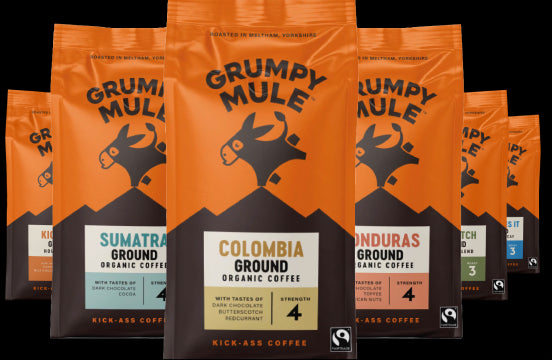
Grab a bag of Grumpy Mule ground coffee and get brewing.
Explore the range and find your next favourite.


